The server you bought at a 15% discount may be a genuine bargain or it may be a grey-market unit with no manufacturer warranty, no security update entitlement, and a serial number that has already been registered to someone else. In the GCC hardware market, the two look identical on a quote. The difference only surfaces when you need warranty support and the manufacturer declines because the unit was never sold through an authorized channel in this region.
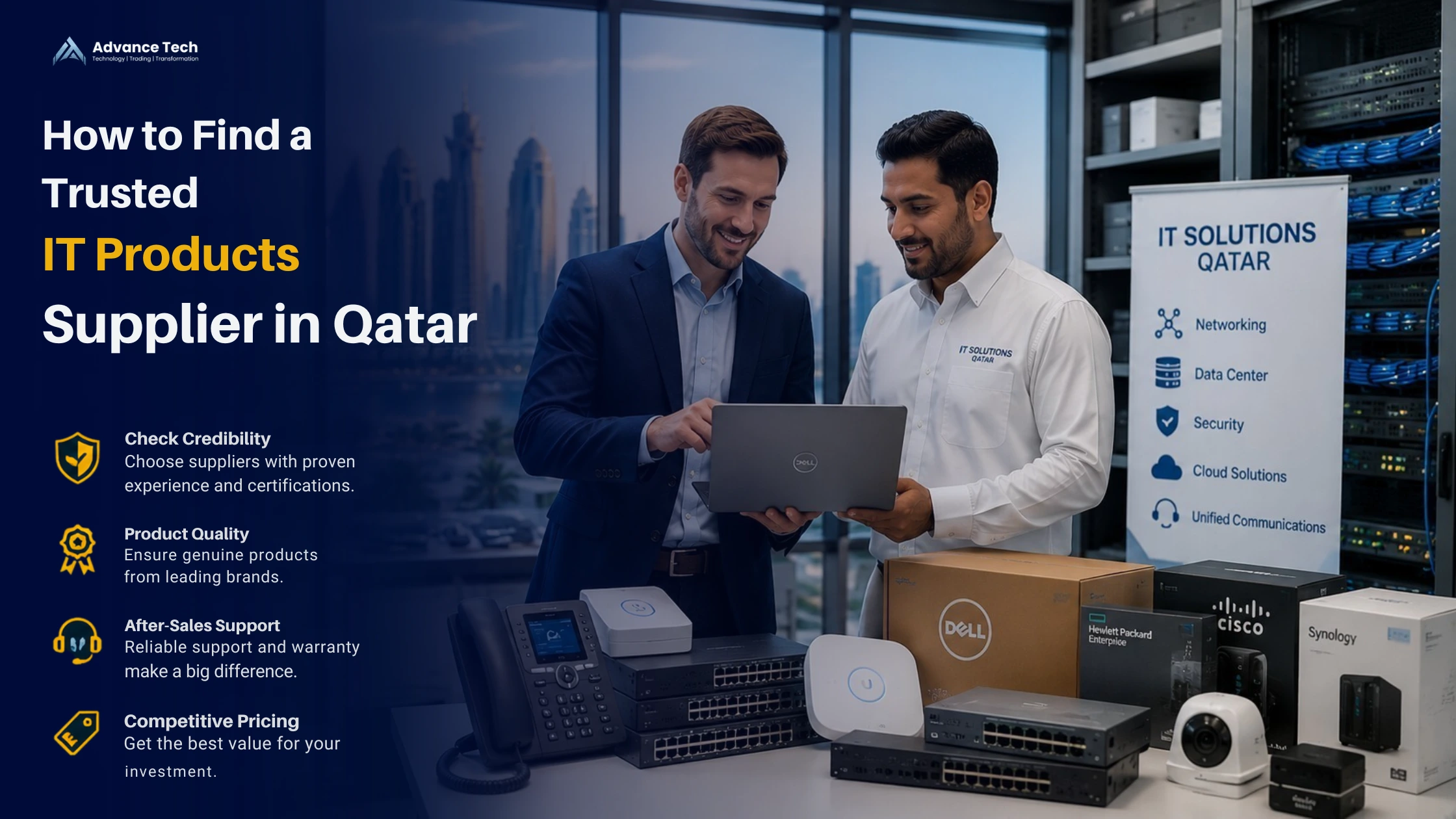
Choosing an IT products supplier in Qatar is, at its core, a question of supply chain integrity. The price comparison that procurement teams run is the easy part; verifying that the hardware is genuine, regionally warranted, and sourced through authorized distribution is the part that protects the organization from buying a liability dressed as a saving.
Why “Authorized” Is the Word That Actually Matters
Plenty of vendors in the regional market will sell you a Dell server, an HP workstation, or a Lenovo laptop. Far fewer are authorized to do so in a way that carries genuine regional warranty and manufacturer support. The distinction is not pedantic it determines whether your hardware is supportable for its entire service life.
Authorized Distribution Versus Grey-Market Sourcing
An authorized distributor has a contractual relationship with the manufacturer, sells products intended for the regional market, and registers warranties that the manufacturer will honour in Qatar. Grey-market hardware is genuine product diverted from another region often bought cheaply elsewhere and resold here which means the warranty may be valid only in its origin market, the firmware may not match regional requirements, and the manufacturer’s regional support organization has no obligation to help. A credible IT products supplier in Qatar sells the former and can prove it; a reseller competing purely on price is frequently moving the latter.
How to Verify Authorization in Ten Minutes
Verification is straightforward when you know what to ask. Request the supplier’s authorization documentation for the specific brands you are buying, and cross-check it against the manufacturer’s partner locator, which most major vendors publish publicly. Ask for the regional part numbers rather than generic model names, since regional SKUs are how manufacturers distinguish product destined for authorized channels. A supplier confident in its authorized distribution relationships provides this without friction; hesitation is the signal worth acting on.
The Real Cost of Counterfeit and Grey-Market Hardware
Warranty and Support That Evaporate When You Need Them
The discount on grey-market hardware is real and visible; the cost is deferred and invisible until something fails. When a grey-market server fails in production and the manufacturer’s regional support declines the claim, the organization absorbs the full replacement cost plus the downtime frequently exceeding the original saving many times over. For mission-critical infrastructure in a Qatar hospital, bank, or government entity, that exposure is not a procurement footnote; it is an operational risk that belongs in the buying decision.
Counterfeit Components and Security Risk
Beyond grey-market diversion, the regional market carries genuinely counterfeit components memory, storage, network modules, and peripherals manufactured to imitate brand-name parts. These fail unpredictably and, in network and security hardware, can introduce a supply-chain security risk: a component whose firmware provenance cannot be verified is a component that has no place in infrastructure handling sensitive data. NIST supply-chain risk management guidance treats hardware provenance as a security control precisely because compromised components are an attack vector. Sourcing genuine IT products in Qatar through verified channels is, in this light, a cybersecurity measure as much as a quality one.
Firmware and Compliance Mismatches
Hardware diverted from another region may ship with firmware, power configurations, or regulatory certifications that do not match Qatar requirements. For regulated environments financial institutions under Qatar Central Bank oversight, healthcare facilities under Ministry of Public Health requirements deploying hardware whose certification and configuration do not match the local regulatory framework creates compliance gaps that an auditor will eventually find.
What a Trusted Supplier Provides Beyond the Box
Stock Availability and Lead-Time Reliability
Enterprise hardware lead times have been volatile, and a project stalled waiting for a server or switch is an expensive delay. A supplier that maintains genuine local stock and holds real distribution relationships can commit to lead times a pure broker cannot. When evaluating an IT hardware distributor in Doha, ask what they actually hold in local stock versus what they would have to source on order the answer separates a supplier from an intermediary.
Pre-Sales Configuration and Compatibility Expertise
A box-mover sells you what you ask for; a real supplier tells you when what you asked for will not work. Server memory configurations, storage controller compatibility, switch licensing, and the interplay between components are where procurement errors happen, and a supplier with genuine technical depth catches these before the purchase order rather than after delivery. This pre-sales engineering capability is part of what distinguishes a supplier that supports system integration projects from one that simply fulfils orders.
Secure Data Sanitization at End of Life
The hardware lifecycle does not end at deployment it ends at disposal, and that is where many Qatar organizations create their most overlooked data risk. Decommissioned drives, servers, and storage arrays carry recoverable data long after they leave the rack, and simply deleting files or formatting a disk does not remove it. Certified data sanitization degaussing and physical destruction using verified equipment such as a ProDevice degausser is what ensures decommissioned media cannot be reconstructed. Under Qatar’s Personal Data Protection Law (Law No. 13 of 2016), and GDPR for organizations with European exposure, the secure destruction of personal data at end of life is a legal obligation, not a courtesy. A supplier who provides certified sanitization with documented destruction certificates closes a compliance gap that informal disposal leaves wide open.
Sector-Specific Sourcing Considerations in Qatar
Healthcare: Provenance and Continuity
Qatar’s healthcare providers operate hardware where both provenance and continuity matter. Clinical systems depend on hardware that carries valid warranty and rapid support, because a failed component in a patient-facing system is not a ticket that can wait. Sourcing through authorized channels with local stock is what makes the support response fast enough for environments where downtime has clinical consequences, and it integrates with the broader healthcare IT environment that these facilities depend on.
Government and Financial: Audit Trails and Documentation
Government entities and financial institutions face procurement scrutiny that informal sourcing cannot survive. Authorized purchase documentation, regional warranty registration, and a clear chain of custody from manufacturer to deployment are what stand up to audit. A supplier who cannot produce this documentation is a supplier whose hardware will eventually become an audit finding.
Comparing Sourcing Channels
The table below summarizes the practical differences Qatar procurement teams weigh when comparing how they source IT hardware.
| Factor | Grey-Market Reseller | Online Marketplace | Authorized Supplier |
| Regional warranty | Often invalid | Unverifiable | Valid and registered |
| Manufacturer support | Frequently declined | Inconsistent | Full entitlement |
| Local stock | Minimal | None | Genuine availability |
| Documentation for audit | Incomplete | Absent | Complete |
For enterprise, healthcare, and government buyers in Qatar, the authorized channel is the only column that survives both a warranty claim and an audit.
How to Run the Vetting Process
The Questions That Separate Suppliers From Brokers
The vetting process does not need to be elaborate; it needs to be specific. Ask the supplier which brands they are authorized to distribute and request the documentation. Ask what they hold in local stock for the products you need. Ask how regional warranty is registered and honoured. Ask what pre-sales technical support they provide. And ask how they handle secure data sanitization at end of life. A supplier built for enterprise relationships answers all five comfortably; one built for price arbitrage struggles past the first.
Building a Relationship, Not Just Placing an Order
The organizations that source hardware well in Qatar treat their supplier as a long-term partner rather than a per-transaction vendor. A supplier who knows your environment, holds stock against your roadmap, and stands behind warranty claims is worth more than the lowest quote on any single purchase order because the value shows up across the hardware’s full lifecycle, not at the moment of sale.