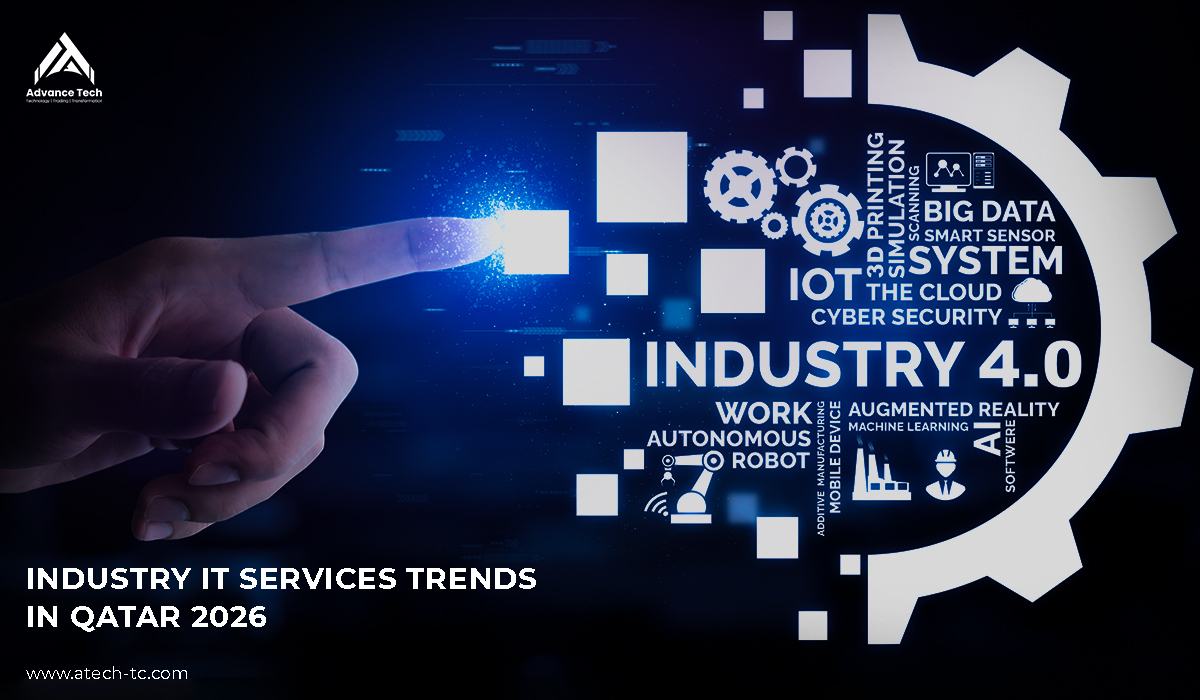
Ask ten IT directors in Doha what changed in 2026 and you’ll get ten different answers pointing at the same underlying shift: IT services in Qatar stopped being about keeping hardware alive and started being about building environments that make decisions on their own. That’s not a marketing phrase. It’s a measurable change in what “managed IT” now includes by default.
As Qatar closes in on National Vision 2030, the pressure isn’t coming from strategy documents anymore, it’s coming from Lusail’s smart city buildout, from healthcare systems that can’t tolerate downtime, and from an economy diversifying fast enough that yesterday’s infrastructure genuinely can’t keep pace.
What Are the Dominant IT Services Trends in Qatar for 2026?
Qatar’s 2026 IT landscape is defined by three converging shifts: Agentic AI replacing single-prompt generative tools with autonomous multi-step workflows, sovereign cloud adoption driven by NCSA compliance pressure, and sustainability becoming a measured, reportable IT metric rather than a side initiative.
None of these are isolated trends. They’re compounding a sovereign cloud decision now has to account for the compute load of agentic AI workflows running on top of it, and both get measured against carbon footprint targets simultaneously.
1. The Rise of Agentic AI and Hyperautomation
2025 was the year companies experimented with generative AI asking questions, getting answers, staying in the loop for every step. 2026 is different in a specific, practical way: Agentic AI systems now execute multi-step workflows without a human triggering each stage.
What that looks like in practice isn’t abstract. A supply chain workflow that used to require a coordinator checking inventory, flagging a reorder, and confirming a shipment now runs those three steps as one autonomous sequence. In healthcare, clinical documentation that used to consume a clinician’s evening now gets drafted, structured, and flagged for review automatically. The shift is from AI that answers to AI that acts which raises the stakes on governance considerably, because an autonomous system making the wrong call at step two compounds the error through steps three and four before anyone notices.
2. Sovereign Cloud and Regionalized IT
Stricter data protection requirements and National Cyber Security Agency (NCSA) oversight have pushed sovereign cloud from a nice-to-have into the default starting position for any new deployment. Businesses evaluating cloud hosting providers in 2026 aren’t just comparing compute pricing anymore they’re weighing which platforms can genuinely guarantee data residency against Qatar’s requirements without quietly routing backups through a foreign region.
This is where cloud computing Qatar infrastructure and IT consulting increasingly intersect. A consultant recommending cloud hosting solutions for a Qatari enterprise in 2026 has to balance global platform capability the scale and AI tooling that Azure or Google Cloud bring against the specific residency and encryption-custody demands local regulation imposes. Getting that balance wrong isn’t a performance problem. It’s a compliance one.
3. Sustainable-by-Design Infrastructure
IT has become a direct contributor to ESG reporting rather than a department that gets asked about it once a year. Green IT in 2026 means data center efficiency and the carbon footprint of AI compute are measured with the same rigor as uptime not because it’s fashionable, but because Qatar’s environmental goals are now baked into how infrastructure investment gets evaluated.
How Is Managed IT Infrastructure Evolving in Doha?
The break-fix model call the provider when something breaks, wait for a technician is functionally dead in any enterprise environment we work with. What’s replaced it is proactive by design, and AI-native networking is the mechanism behind that shift.
From Reactive to Predictive Maintenance
Modern networks in Qatar are increasingly self-monitoring. Providers apply machine learning to detect fault patterns and optimize traffic flow before a human operator would even see an alert. For Qatar’s industrial and energy sectors specifically, this isn’t a convenience feature unplanned downtime in those environments costs real money at a scale that makes predictive maintenance pay for itself quickly.
The Shift to SASE and Zero Trust
With hybrid work now a permanent operating condition rather than a pandemic-era exception, Secure Access Service Edge (SASE) has become the standard architecture. SASE converges wide-area networking with security services into a single framework practically, this means a consultant working from Msheireb gets the identical security posture as an executive sitting in a West Bay headquarters. Location stops being a variable in your security model, which is exactly the point.
What to Look for in a System Integrator in Qatar
Selecting a technology partner in 2026 isn’t a catalog exercise anymore it’s a due-diligence exercise, and the criteria that actually predict a successful partnership are narrower than most RFPs suggest.
| Evaluation Criteria | What to Actually Verify | Why It Matters |
|---|---|---|
| Sector-Specific Certification | Understanding of Qatari healthcare uptime requirements or MCIT security standards | Generic IT competence doesn’t transfer to regulated-sector requirements |
| Engineering Sovereignty | A local Doha-based team of certified engineers, not remote-only support | Determines response time when something fails outside business hours |
| Compliance Knowledge | Fluency in Qatar Data Privacy Law and NCSA frameworks | A partner who stalls on compliance stalls your entire project timeline |
| System Integration Depth | Physical infrastructure expertise, not just software licensing | Cloud and AI tools fail without the underlying network and hardware built correctly |
The pattern worth watching for: a provider that can speak fluently about global platforms but goes vague the moment you ask about local regulatory specifics. That vagueness is usually a sign of remote support, not local depth.
Why Advance Tech Qatar Is Trusted for Industry IT Services
The Qatari market is crowded with global resellers moving product. We’ve built our position differently through local presence and certified reliability across the sectors where getting it wrong isn’t an option.
What that looks like in practice:
- Sector depth: We’re a primary technology partner across government, healthcare, and education in Qatar, which means our solutions are built against the highest national standards from the start, not adapted to them afterward
- Authorized expertise: As an authorized distributor for global leaders, we supply genuine warranty-backed hardware, including rugged Soten industrial tablets and medical-grade KSI devices, integrated by our own local specialists rather than passed off to a third party
- Regulatory alignment: Our engineering team works inside Qatar’s specific regulatory landscape daily, which means digital transformation projects are compliant from day one instead of retrofitted for compliance later
- Comprehensive lifecycle support: We don’t move boxes and disappear. IT infrastructure design, cybersecurity implementation, and long-term managed IT services all sit under one relationship, not three separate vendors
Moving From Strategy to Implementation
The 2026 IT landscape genuinely requires a partner fluent in both global trends and the specific realities of operating in Qatar. A system integration approach that treats compliance, physical infrastructure, and cloud strategy as one connected problem rather than three separate line items.
The goal for Qatari enterprises this year isn’t just adopting new technology. It’s technology that’s governed, secure, and scalable at the same time, Three requirements that tend to work against each other unless the underlying architecture was built to hold all three from the start.
Looking to optimize your organization’s digital footprint and close the gap to National Vision 2030? Contact Advance Tech Qatar to discuss where your infrastructure stands today.
People Also Ask
What are the biggest IT services trends in Qatar for 2026?
The key trends include Agentic AI executing autonomous workflows, sovereign cloud adoption driven by NCSA compliance, predictive managed IT services, and sustainable, ESG-aligned IT infrastructure.
Why is sovereign cloud important for businesses in Qatar?
Sovereign cloud ensures compliance with Qatar Data Privacy Law and NCSA regulations by keeping sensitive data hosted securely within the country, rather than routed through foreign data centers by default.
How are managed IT services changing in Doha?
Managed IT services in Doha now center on AI-driven predictive maintenance, proactive network monitoring, and Zero Trust security through SASE architecture, replacing the older reactive break-fix support model.
What should companies look for in a Qatar-based system integrator?
Organizations should prioritize local engineering expertise based in Doha, sector-specific certifications relevant to their industry, and proven, current knowledge of Qatar’s regulatory frameworks.