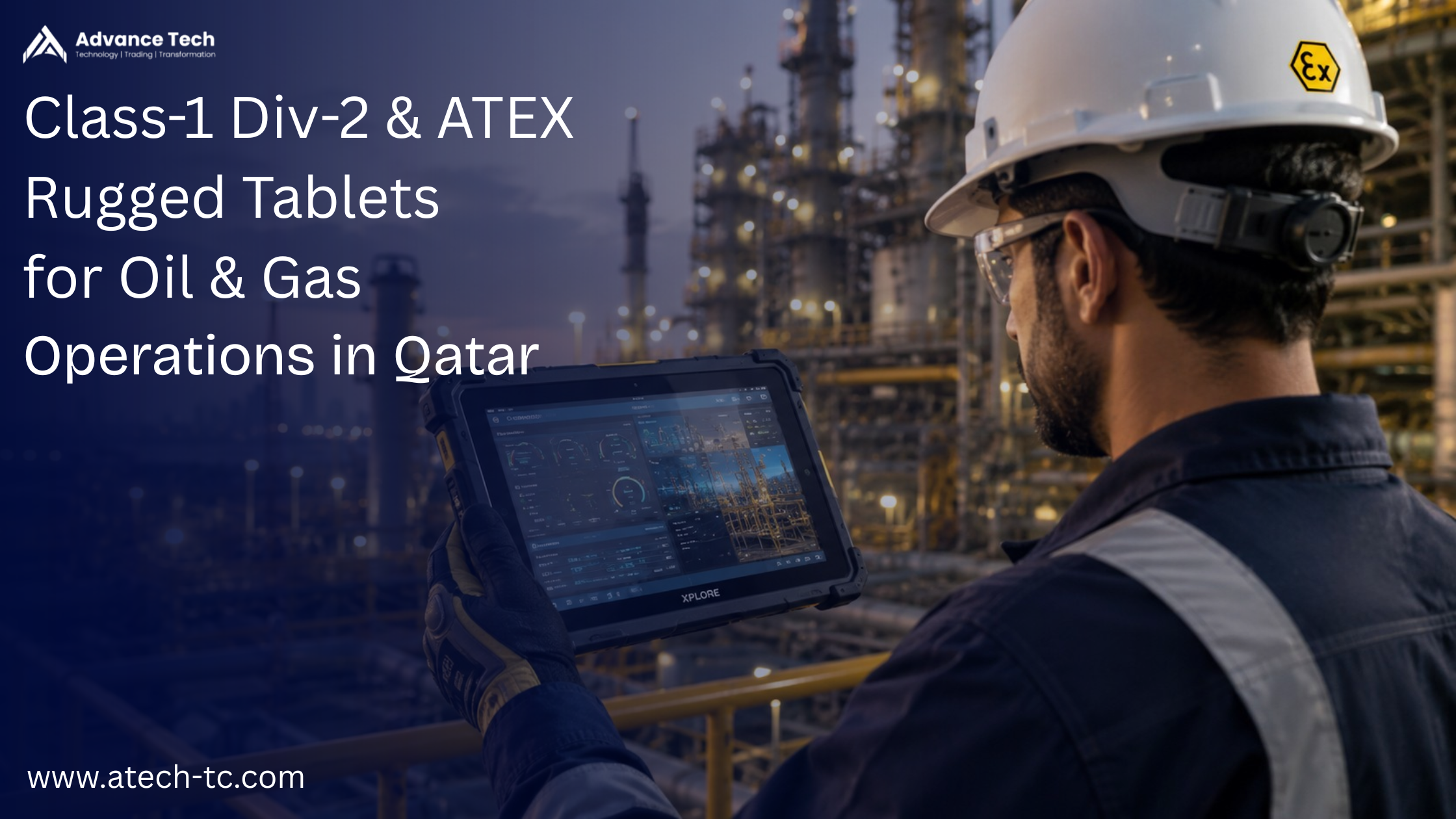
Walk onto any active site in Ras Laffan or Mesaieed and you’ll notice something: the paper clipboard is disappearing. In its place is a rugged tablet, usually strapped to a technician’s forearm or mounted on a rig console. That shift isn’t cosmetic. It’s the direct result of Qatar’s oil and gas operators racing to digitize inspection, maintenance, and safety workflows across some of the biggest LNG expansion projects on the planet.
This is exactly why demand for rugged tablets oil and gas Qatar operators can actually deploy in hazardous zones has picked up so fast. But here’s the catch nobody puts on the marketing slide: not every tablet that survives a drop test is legally allowed inside a hazardous zone. Get this wrong, and you’re not just risking a broken screen. You’re risking an ignition source in a hydrocarbon-rich environment.
Modernizing Field Operations in Qatar’s Oil & Gas Sector
The Digital Transformation of Ras Laffan and Mesaieed Assets
Offshore field operations and onshore processing plants alike are under pressure to digitize faster than their legacy IT hardware can keep up with. Five years ago, a lot of inspection data in Qatar’s processing plants still lived on paper forms, radioed back to a control room, then manually keyed into a system hours later. That gap between what happened in the field and what the system knows is exactly where costly mistakes hide.
The North Field Expansion projects have forced a change. Digital twin updates, edge data processing, and real-time asset tracking are now baseline expectations, not nice-to-haves. Field crews are expected to log a valve inspection, flag an anomaly, and sync it to SCADA before they’ve even walked to the next station. That level of responsiveness needs hardware that can keep up, hardware that’s also cleared to operate where hydrocarbons are present, under Qatar Energy’s HSE frameworks.
The Cost of Uncertified IT Hardware in Hazardous Zones
Here’s a mistake that’s more common than you’d think: a site engineer picks up a consumer-grade rugged tablet because it looks industrial, without checking whether it’s actually rated for the zone it’s going into.
A standard tablet, even a tough one, carries electrical components that can spark. In a Class 1 Division 2 or ATEX Zone 2 environment, anywhere flammable gas or vapor could be present under abnormal conditions, that spark is a real ignition risk. Beyond the safety exposure, non-compliant deployments create three headaches operators can’t afford:
• Operational downtime when auditors pull equipment from service mid-project
• Regulatory penalties tied to Qatar Energy and QP-affiliated compliance mandates
• Insurance complications if an incident traces back to uncertified electronics on site
None of this is theoretical. Site HSE teams increasingly ask for certification paperwork before hardware even gets past the gate.
Navigating Certifications: Class 1 Div 2 vs. ATEX Zone 2 for Qatar Operations
Decoding Safety Standards (C1D2, ATEX, IECEx)
Hazardous area computing lives or dies on getting this classification right before hardware ever reaches site. This is where a lot of procurement conversations get muddled, so let’s separate the terms properly.
| Standard | Origin | What It Covers | Where It’s Typically Required in Qatar |
| Class 1 Division 2 (C1D2) | North American (NEC/NFPA) | Areas where ignitable gas is not normally present but could occur under abnormal conditions | Common on projects using US-based engineering standards or equipment specs |
| ATEX Zone 2 | European Union directive | Similar risk profile to C1D2, gas present infrequently and briefly | Widely referenced across Qatar’s onshore and offshore facilities |
| ATEX Zone 1 | European Union directive | Gas is likely to be present during normal operation | Higher-risk zones near wellheads, separators, and process units |
| IECEx | International (IEC) | Global certification scheme, often used alongside ATEX for cross-border equipment recognition | Preferred for equipment moving between regional operators |
For Qatar specifically, onshore processing plants often lean on ATEX Zone 2 or IECEx documentation because of the strong European engineering influence in the region’s EPC contracts. Offshore platforms, where gas presence is less predictable but the consequences of ignition are severe, frequently push requirements up to Zone 1. The practical takeaway: don’t assume one certification covers every site. Check the zone classification for the specific facility before specifying hardware.
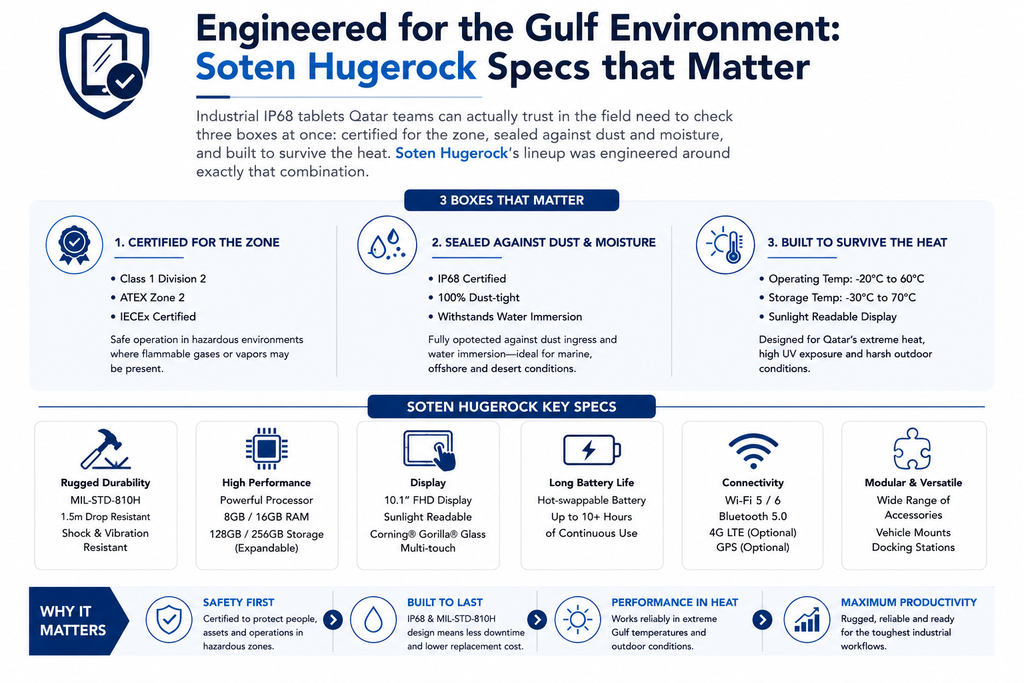
Intrinsic Safety Engineering in Soten Hugerock Devices
Certification isn’t a sticker slapped on after the fact, it’s built into how the device is engineered. Soten Hugerock’s hazardous-area tablet series is built around a few core principles:
• Spark-proof circuitry designed so internal electrical faults can’t generate enough energy to ignite surrounding gas
• Sealed, intrinsically safe battery architecture that limits current and voltage to safe thresholds even under fault conditions
• Certified enclosure seals that prevent gas ingress into the device housing
• MIL-STD-810G/H drop and shock testing, so a tablet dropped from a platform walkway or rig deck doesn’t compromise its sealed housing
That last point matters more than people expect. A device can be electrically safe on paper, but if the enclosure cracks after a two-meter drop onto a steel deck, the intrinsic safety rating goes out the window along with it.
Engineered for the Gulf Environment: Soten Hugerock Specs that Matter
Industrial IP68 tablets Qatar teams can actually trust in the field need to check three boxes at once: certified for the zone, sealed against dust and moisture, and built to survive the heat. Soten Hugerock’s lineup was engineered around exactly that combination.
Surviving Qatar’s Climate: Direct Sunlight & Thermal Extremes
This is the part a lot of imported hardware quietly fails at. A rugged tablet designed for a European warehouse or a US construction site wasn’t necessarily built for a Ras Laffan afternoon in July, when ambient temperatures push toward 50°C and asphalt or steel surfaces run even hotter.
Two things tend to go wrong first: the screen becomes unreadable in direct sun, and the device starts thermal throttling or shutting down to protect the battery. Soten Hugerock addresses both directly:
• High-brightness displays, ranging from 1,000 nits up to 2,600 nits depending on the model, stay legible even in harsh desert or marine glare
• Advanced thermal dissipation design manages heat before it reaches the battery or CPU, reducing the risk of swelling, throttling, or unexpected shutdowns during peak summer months
If you’ve ever watched a technician squint at a washed-out screen mid-shift or restart a tablet that shut itself down from heat, you already know why this spec sheet detail isn’t just marketing filler.
Enterprise Connectivity and Modular Field Features
Hardware that’s certified and heat-resistant still needs to actually do the job, which means staying connected and usable in real field conditions. Relevant capabilities include:
• 5G/4G LTE and Wi-Fi 6 for reliable data sync between remote assets and the control room
• High-accuracy GNSS (L1+L5) for precise asset location tracking, important when tagging equipment across sprawling onshore facilities
• Integrated RFID and barcode scanners for fast asset identification during inspection rounds
• IP68-rated, glove-compatible, wet-finger touchscreens built to handle salt spray, dust storms, and technicians wearing standard PPE gloves
A touchscreen that only responds to bare fingers is a non-starter offshore. Most crews are gloved up the entire shift, and a device that forces them to remove PPE just to log data is a device that gets abandoned within a month.
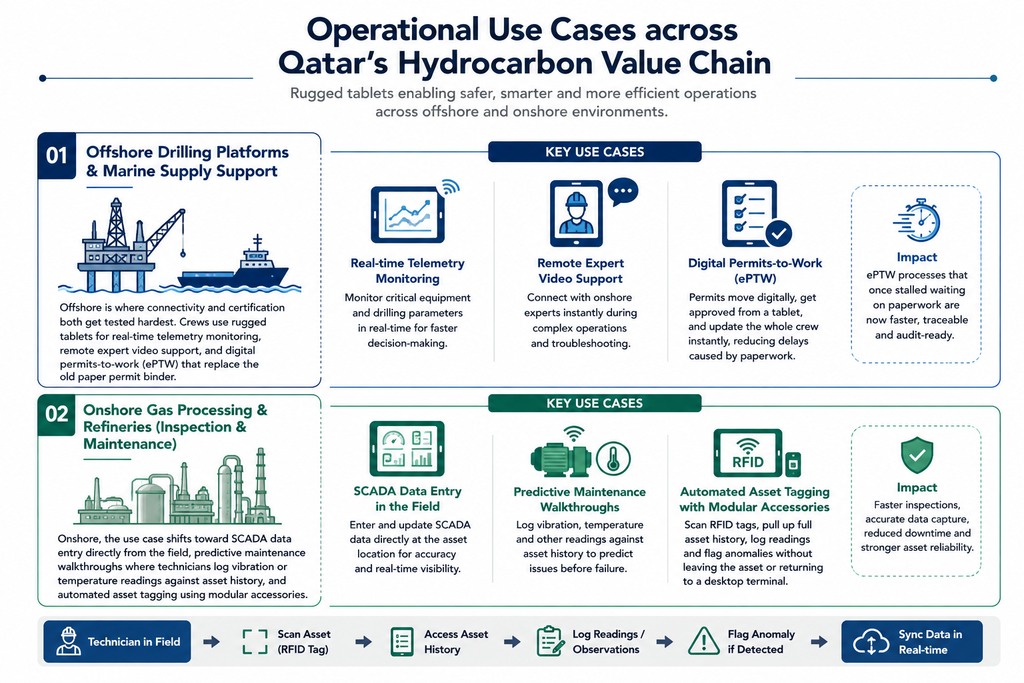
Operational Use Cases across Qatar’s Hydrocarbon Value Chain
Offshore Drilling Platforms & Marine Supply Support
Offshore is where connectivity and certification both get tested hardest. Crews use rugged tablets for real-time telemetry monitoring, remote expert video support during complex procedures, and digital permits-to-work (ePTW) that replace the old paper permit binder.
The ePTW use case alone is worth highlighting. Instead of a permit sitting in a supervisor’s office waiting for a signature, it moves digitally, gets approved from a tablet, and updates the whole crew instantly. That shaves real time off procedures that used to stall waiting on paperwork.
Onshore Gas Processing & Refineries (Inspection & Maintenance)
Onshore, the use case shifts toward SCADA data entry directly from the field, predictive maintenance walkthroughs where technicians log vibration or temperature readings against asset history, and automated asset tagging using modular accessories.
A maintenance technician doing a round inspection can now scan an RFID tag on a pump, pull up its full maintenance history, log a reading, and flag an anomaly, all without leaving the asset or waiting to get back to a desktop terminal.
Procurement Advantage: Why Partner with Local IT Trading Services in Qatar
Eliminating Logistics & Compliance Friction
Local Soten Hugerock distribution changes this equation entirely. Direct overseas import sounds simpler on paper. In practice, it usually isn’t. Custom clearance delays, missing regional compliance documentation, and zero local testing before deployment are the three most common headaches procurement teams run into when they skip local channels.
Working with a local IT Trading partner in Qatar solves that friction in a few concrete ways:
• Local inventory availability so there’s no waiting weeks for a shipment when a device fails mid-project
• Direct warranty support handled regionally instead of routed through an overseas manufacturer
• Dedicated regional SLAs that match project timelines, not generic international shipping windows
For a project running on North Field Expansion timelines, a two-week import delay on a critical device isn’t an inconvenience, it’s a schedule risk.
Customized Soten Hugerock Deployment Solutions
Good local partners don’t just ship boxes. They handle client-specific staging before the device ever reaches the field:
• Mobile Device Management (MDM) pre-configuration, so tablets arrive locked down to approved apps and workflows
• Custom vehicle and rig mounting solutions for hands-free operation in vehicles or fixed installations
• Site-specific software loadouts matching whatever SCADA, SAP, or GIS inspection tools the operator already runs
This staging work is easy to underestimate until you’re the one unboxing forty tablets on site and realizing none of them are configured the same way.
Streamlining Hazardous Area IT Procurement
Before signing off on any rugged tablet purchase for a Qatar oil and gas deployment, run through this checklist:
• Confirm the exact zone classification (C1D2, ATEX Zone 2, or Zone 1) required for the specific facility
• Verify IECEx or ATEX documentation matches the certification claimed by the vendor
• Check thermal performance specs against actual Gulf summer conditions, not generic rugged claims
• Confirm glove-touch and IP68 sealing for offshore or dusty onshore environments
• Ask whether the supplier offers local staging, MDM configuration, and regional warranty support
Getting hazardous-area hardware right isn’t about finding the toughest-looking tablet on a spec sheet. It’s about matching certification, climate resilience, and field workflow to the actual conditions your crews are operating in every single shift.
If you’re evaluating rugged tablets oil and gas Qatar operators need for an upcoming Ras Laffan or Mesaieed deployment, what’s the bigger constraint on your end right now: certification paperwork, thermal performance, or getting devices staged and into the field on schedule?
Ready to Deploy Certified Rugged Tablets on Your Site?
Advance Tech Trading & Contracting is the local IT Trading partner for Soten Hugerock rugged tablets in Qatar, offering ATEX Zone 2/Zone 1 and C1D2-certified devices, local inventory, MDM staging, and regional warranty support built for Ras Laffan and Mesaieed operating conditions. Request your customized product catalog or RFQ today.