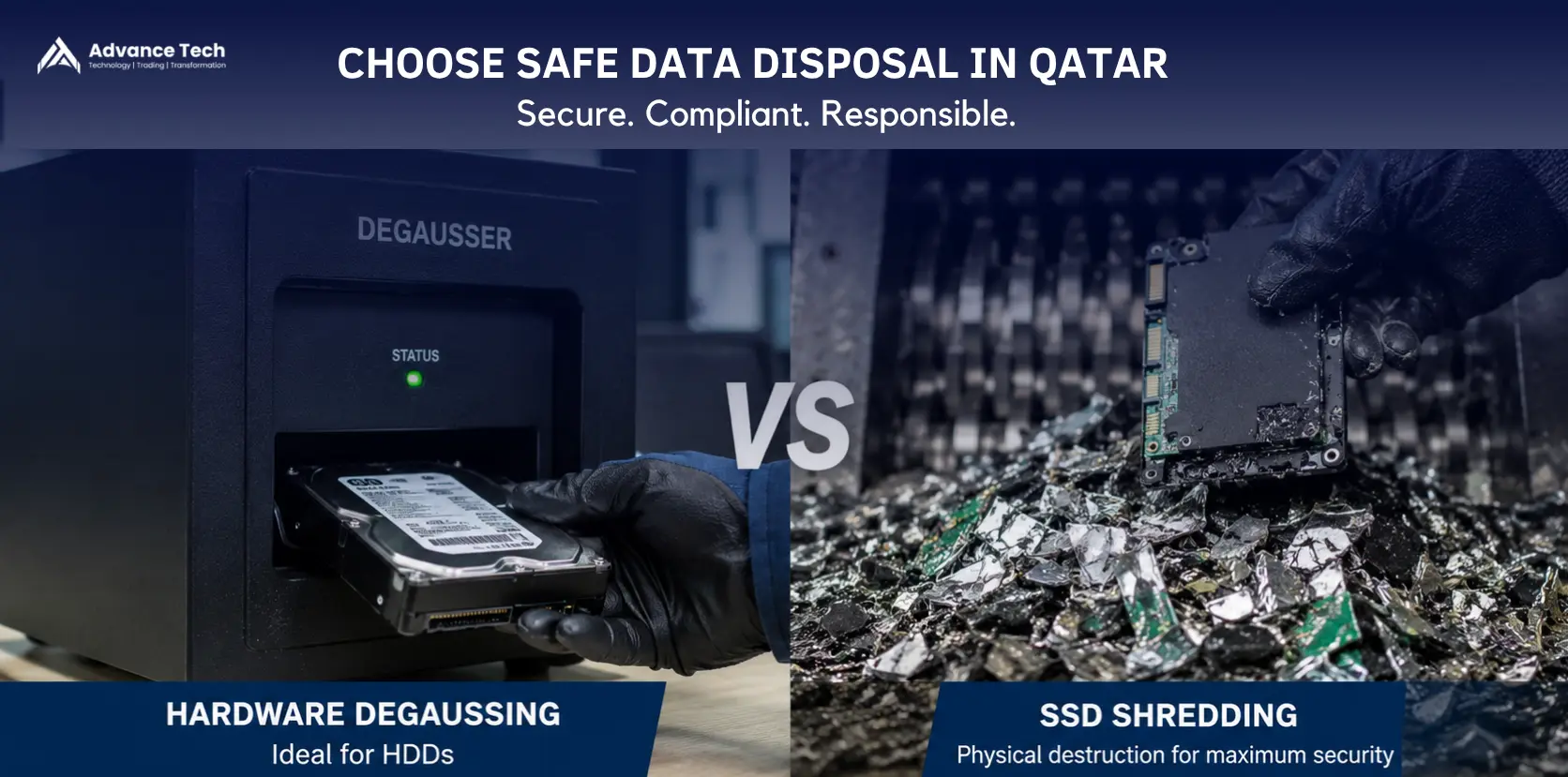
Here’s a mistake that shows up in more Doha data centers than you’d expect: an IT team buys a magnetic degausser, runs every retired drive through it, and files the paperwork as compliant. Then someone checks the batch and half of it was SSDs. Those drives walked out the door with the data fully intact.
Getting certified data disposal Qatar regulators actually recognize means understanding that degaussing and shredding aren’t interchangeable. They work on completely different physics, and using the wrong one on the wrong media type isn’t a minor technicality, it’s a compliance failure waiting to surface during an audit or, worse, a breach investigation.
The Evolving Risk of Legacy Hardware Disposal in Qatar
A quick format looks final. It isn’t. Standard OS quick-formats and basic wiper utilities remove the file table pointers, not the underlying data, which means forensic recovery tools can pull those fragments back with surprisingly little effort.
Doha’s data center refresh cycles are generating a steady stream of retired HDDs, SSDs, and backup tapes every year. Multiply that across banks, government entities, and telecoms upgrading infrastructure on a rolling basis, and you get a real volume problem, not just an occasional edge case.
The Regulatory Cost of Data Leakage (Qatar PDPPL & NCSA Guidelines)
Qatar’s Personal Data Privacy Protection Law, Law No. 13 of 2016, doesn’t leave much room for interpretation on this point. Article 10 requires that personal data be erased or disposed of once the purpose of processing ends, and that requirement extends directly to the physical media that data lives on.
For financial institutions, government entities, and healthcare providers in particular, the exposure isn’t just regulatory. A drive that surfaces with recoverable patient records or account data attached to your organization’s name is a reputational hit that outlasts any fine attached to it.
Hardware Degaussing: The Gold Standard for Magnetic Storage (HDDs & Tapes)
Any magnetic degausser supplier Doha organizations trust will start the conversation here. Degaussing works by subjecting a platter-based drive to an extremely high-intensity magnetic field, typically in the 1.1 Tesla and up range, or roughly 11,000 Gauss or higher depending on the equipment.
That field completely scrambles the magnetic domains the drive relies on to store data. It also wipes out the servo tracks the drive head needs to even locate data on the platter, which means the drive isn’t just data-free, it’s mechanically unusable afterward.
The SSD Blindspot: Why Degaussers Fail on Flash Memory
This is the part that catches people out. SSDs, NVMe drives, M.2 modules, and USB flash drives don’t store data magnetically at all. They hold it as electrical charges trapped in floating-gate transistors on a flash memory chip.
Run that drive through a degausser and nothing happens to the stored data, because there’s no magnetic domain to disrupt in the first place. Treating degaussing as a one-size-fits-all destruction method for a mixed fleet is a real compliance gap, and it’s one that’s easy to miss until an audit specifically asks how each media type was handled.
Quick reference for matching media type to method:
| Media Type | How It Stores Data | Correct Destruction Method |
| HDDs & Magnetic Tapes | Magnetic domains on spinning platters or tape | Degaussing (1.1+ Tesla) — optionally followed by shredding |
| SSDs, NVMe, M.2, USBs | Electrical charges held in floating-gate flash transistors | Physical shredding or pulverizing — degaussing has no effect |
| Mixed fleets | Combination of the above across a data center refresh | Sort by media type first, then apply the matching method to each |
SSD Physical Shredding: Total Destruction for Solid-State Architectures
ProDevice HDD shredders and their solid-state counterparts approach this differently than a degausser ever could. Industrial SSD shredders, like ProDevice’s SG150 and DG40 units, use hardened steel cutters to crush and shear drives down to fragment sizes small enough that the underlying chip structure can’t be reassembled.
Particle size isn’t a cosmetic detail, it’s the actual NIST 800-88 compliance requirement. NIST 800-88’s Destroy guidance specifies fragment sizing precisely because flash chips hold data in a physical structure, and destroying that structure is what makes recovery genuinely impossible rather than just difficult.
The Degauss-Then-Shred Strategy for High-Security Environments
For organizations handling highly sensitive data, banking cores, government records, healthcare systems, a single destruction method is often not enough on its own. The defense-in-depth approach is to degauss magnetic media first, purging the data at the field level, then physically shred it for structural destruction on top.
It’s belt and suspenders, and for high-security environments in Qatar that’s exactly the posture regulators and auditors expect to see documented.
ProDevice Sanitization Ecosystem: Precision, Security, and Compliance
The ProDevice ASM120 and ASM240 degaussers operate in the 11,000 to 22,000 Gauss range, or roughly 1.1 to 2.2 Tesla, with fast cycle times that don’t force a choice between thoroughness and throughput on a busy decommissioning day.
• Integrated camera and barcoding systems: each drive is imaged and its serial number logged automatically at the point of destruction
• PPMS (Pre-Paid Management System): built-in usage tracking that keeps the degausser’s operational history documented
• Tamper-proof certificates: serial numbers, discharge power levels, and date/time stamps compile automatically into an audit-ready certificate of destruction
That last piece is what turns a destruction event into actual evidence. When an auditor asks for proof a specific drive was destroyed on a specific date at a specific field strength, a generic spreadsheet doesn’t cut it. A tamper-proof, serial-linked certificate does.
Heavy-Duty Industrial Shredding Solutions
On the shredding side, ProDevice’s industrial units are built to take mixed media batches, HDDs, SSDs, tablets, smartphones, directly on-site rather than requiring drives to be boxed up and shipped to a third-party facility. That on-site capability alone removes one of the biggest chain-of-custody risks in the whole process: the transport gap.
Implementing a Certified IT Asset Disposal (ITAD) Workflow in Qatar
Outsourcing destruction to a third party sounds convenient, until you map out how many hands and how many transport legs your drives pass through before they’re actually destroyed. Every one of those steps is a gap in the chain of custody you can’t fully verify.
Owning dedicated ProDevice hardware in-house closes that gap entirely. Drives never leave the building, and every destruction event is logged by your own team with your own serial-linked certificates.
Where compliance tiers fit into procurement decisions:
| NIST 800-88 Tier | What It Means | Typical Use Case |
| Clear | Logical technique such as a standard overwrite, reversible with the right tools | Low-sensitivity devices being reused internally |
| Purge | Physical or logical technique that resists laboratory-level recovery, such as degaussing | Magnetic media leaving the organization but not being destroyed |
| Destroy | Physical destruction that renders the media unusable for any storage purpose | End-of-life drives, especially SSDs, holding regulated or sensitive data |
A short checklist worth running through before procurement teams commit to destruction equipment:
• Confirm the equipment’s field strength (Gauss/Tesla) matches your magnetic media volume and drive types
• Verify shredder particle output meets NIST 800-88 Destroy sizing for flash memory
• Check whether serial-level chain-of-custody reporting is automated or manually logged
• Confirm the equipment supports on-site operation for mixed media batches
• Ask for a sample tamper-proof certificate of destruction before signing off
Future-Proofing Data Destruction in Qatar
The core rule is simple even if the compliance paperwork around it isn’t: magnetic media gets degaussed, ideally followed by shredding for high-security data, and flash-based media gets shredded or pulverized, full stop. Degaussing an SSD isn’t a shortcut, it’s a false sense of security.
As Doha’s data centers keep refreshing hardware at pace, the organizations that treat media destruction Qatar regulators expect as a documented, serial-tracked process, not just a box-ticking exercise, are the ones that walk into a PDPPL audit without a scramble.
Is your current certified data disposal Qatar process actually sorting media by type before destruction, or is everything still going through the same machine regardless of what’s inside?
Ready to Close the Gap in Your Data Destruction Process?
Advance Tech Trading & Contracting is the local cybersecurity trading partner for ProDevice data destruction hardware in Qatar, offering high-Tesla degaussers, industrial SSD shredders, and NIST 800-88 compliant sanitization workflows with tamper-proof audit reporting. Request a ProDevice product demonstration or hardware consultation today.
Visit: www.atech-tc.com