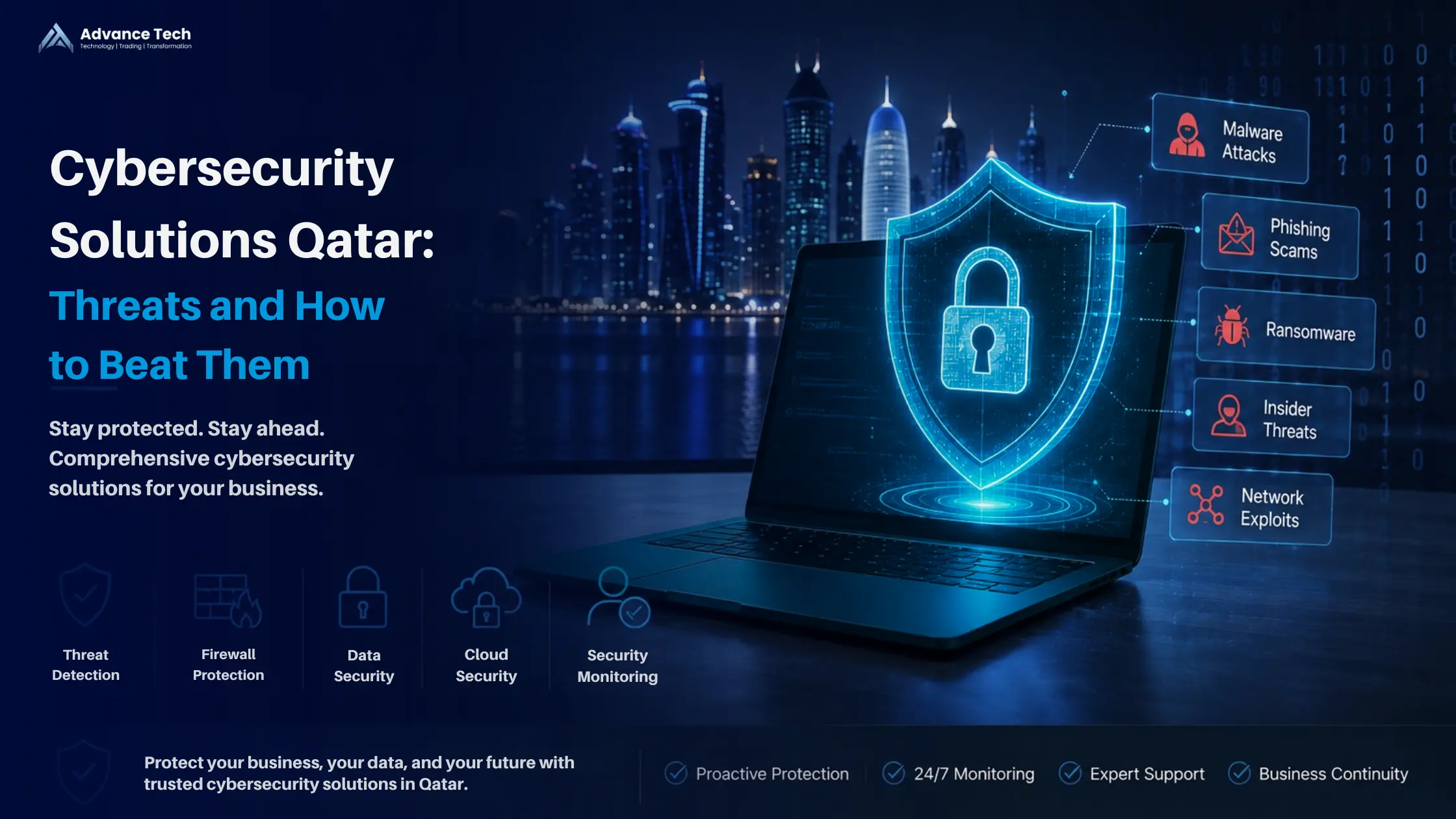
The breach that takes down a Qatar organization is rarely sophisticated. It is a finance clerk wiring funds to a spoofed supplier account, an unpatched server exposed to the internet, or a contractor’s compromised laptop carrying malware onto the corporate network. The attacker did not need a zero-day exploit they needed one gap in a defence that looked complete on paper.
Qatar’s rapid digitization under National Vision 2030, the concentration of high-value targets in finance, energy, and government, and the region’s geopolitical profile make it a focus for both financially motivated and state-aligned threat actors. Building effective cybersecurity solutions in Qatar means understanding the specific threats organizations here face and closing the gaps that attackers actually exploit, not the ones that are easiest to address.
The Threat Landscape Qatar Businesses Actually Face
Generic threat lists are not useful for decision-making. What matters is which threats are hitting Qatar organizations, how they get in, and where the defensive priorities should sit. The pattern across the region is consistent enough to plan around.
Business Email Compromise and Phishing
The highest-frequency, highest-loss attack vector for Qatar enterprises is not malware it is email-based fraud. Business email compromise, where attackers impersonate executives or suppliers to redirect payments, costs organizations more in direct financial loss than most other attack types combined. Phishing campaigns harvest the credentials that then enable everything else: lateral movement, data theft, ransomware deployment. The reason this vector dominates is simple it targets people, and people are present in every organization regardless of how strong the technical controls are.
Effective defence requires layered email security solutions that combine technical filtering with verification processes for financial transactions. The technology catches the bulk of malicious mail; the process catches the targeted attack that slips through, by requiring out-of-band confirmation before funds move. Organizations that rely on the technology alone, without the process, remain exposed to exactly the attacks that cause the largest losses.
Ransomware and the Cost of Downtime
Ransomware remains a severe threat, and its impact in Qatar is amplified by the operational criticality of the targets. For a hospital, ransomware is not a data problem it is a patient-safety problem when clinical systems go dark. For a logistics or energy operation, it is a continuity problem measured in cost per hour of downtime. Modern ransomware operators also exfiltrate data before encrypting it, adding extortion and regulatory exposure under Qatar’s Personal Data Protection Law to the operational damage.
The defence is not a single product but an architecture: network segmentation that limits how far an infection spreads, tested backups that are isolated from the production environment, endpoint detection that catches the intrusion early, and an incident response plan that has been rehearsed before it is needed. Organizations discover the gaps in this architecture during the attack, which is the most expensive time to find them.
Insider Risk and Third-Party Exposure
Not every threat comes from outside. Qatar’s project-based economy means a high volume of contractors, consultants, and third-party vendors with varying degrees of network access and each one expands the attack surface. The compromise frequently arrives not through the organization’s own systems but through a trusted third party’s weaker security. Supply-chain and contractor access controls are the part of the security posture that organizations most often neglect, because the access was granted for legitimate operational reasons and never revisited.
Compliance Is a Floor, Not a Ceiling
Qatar’s Regulatory Framework
Qatar’s Personal Data Protection Law (Law No. 13 of 2016) imposes obligations on how organizations collect, process, and protect personal data, with penalties for breaches and requirements for safeguarding data throughout its lifecycle. For organizations operating in the Qatar Financial Centre, additional data protection regulations apply. Entities handling government data fall under National Cyber Security Agency frameworks that specify security controls and documentation requirements. Organizations with European operations or data subjects carry GDPR obligations on top.
Meeting these requirements is necessary, but compliance and security are not the same thing. A compliant organization has satisfied a documented checklist; a secure organization has closed the gaps an attacker would exploit. The two overlap substantially, but treating the compliance checklist as the security strategy leaves the gaps that fall between the regulatory requirements and attackers operate precisely in those gaps. The right posture uses frameworks like NIST and ISO 27001 as the structure and then exceeds the minimum where the organization’s actual risk profile demands it.
Building Toward a Recognized Framework
The NIST Cybersecurity Framework provides a structure that maps well to Qatar’s regulatory environment: identify the assets and risks, protect them with appropriate controls, detect intrusions, respond to incidents, and recover operations. Working toward a recognized framework gives an organization a defensible, auditable security posture rather than a collection of disconnected tools. It also provides the documentation that Qatar regulators and enterprise clients increasingly require as evidence of due diligence. Coherent cybersecurity solutions are built on this kind of framework rather than assembled product by product without an organizing structure.
The Layered Defence That Actually Works
Network Security as the Foundation
Security begins at the network layer, where proper segmentation contains the damage when something does get through. A flat network where every device can reach every other device means a single compromised endpoint exposes the entire environment. Segmentation isolates critical systems, separates user traffic from server traffic, and creates the controlled boundaries that limit lateral movement. This is where security architecture and network infrastructure are inseparable the network design determines how much of the environment an attacker can reach after the initial breach.
Next-generation firewalls add application-aware filtering, intrusion prevention, and the inspection of encrypted traffic where threats increasingly hide. As a Fortinet partner and through other enterprise platforms, properly configured perimeter and internal network controls form the layer that catches a large share of threats before they reach their target. The emphasis is on configuration a powerful firewall with default or careless rules provides far less protection than its specification suggests.
Endpoint Protection Beyond Antivirus
The endpoint laptop, desktop, server, mobile device is where most attacks ultimately land, and traditional signature-based antivirus is no longer sufficient against modern threats. Endpoint detection and response platforms monitor behaviour, identify the anomalies that indicate compromise, and enable rapid isolation of an affected device before an infection spreads. For Qatar organizations with mobile workforces and a mix of corporate and personal devices, robust endpoint security solutions are the control that addresses the reality that the perimeter now extends to wherever the user is working.
Identity, Access, and the Principle of Least Privilege
A recurring finding in compromised environments is excessive access: users, service accounts, and contractors with permissions far beyond what their role requires. Every unnecessary permission is an additional path an attacker can exploit once they compromise that account. Strong identity management multi-factor authentication, least-privilege access, and regular review of who can reach what closes a category of risk that no perimeter product can address, because the attacker using valid stolen credentials looks legitimate to the systems checking them.
What Goes Wrong in Practice
The Tool Sprawl Problem
A common pattern in Qatar organizations that have invested in security: a collection of products bought reactively, each addressing a specific concern, none integrated, and collectively generating more alerts than the team can process. The result is a high spend that produces a false sense of security while real threats sit unnoticed in the alert noise. Security effectiveness comes from an integrated architecture with the visibility to correlate events across layers, not from the number of products deployed. Consolidation and integration frequently improve security while reducing cost the opposite of the assumption that more tools mean more protection.
The Skills Gap and Alert Fatigue
Qatar, like the wider region, faces a shortage of experienced cybersecurity professionals. Organizations deploy capable tools and then lack the staff to monitor them, tune them, and respond to what they report. Sophisticated detection that nobody is watching provides little protection. This is why many organizations turn to managed security services or partners who provide the monitoring and response capability that is difficult and expensive to build and retain in-house particularly the around-the-clock coverage that threats operating across time zones demand.
Security as a Project Instead of a Process
The most consequential mistake is treating security as a one-time implementation. The threat landscape changes continuously, new vulnerabilities emerge constantly, and the organization’s own environment evolves with every new system and user. A security posture established and then left static degrades from the day it is deployed. Effective security is an ongoing process of monitoring, patching, reviewing, and adapting not a project with a completion date. Organizations that treat their initial security investment as finished are protected against last year’s threats while this year’s go unaddressed.
Aligning Security Investment With Actual Risk
Security spending should follow risk, and risk differs by organization. A hospital’s priority is the availability and integrity of clinical systems and the protection of patient data under PDPL and clinical confidentiality obligations. A financial institution’s priority is transaction integrity, fraud prevention, and the stricter regulatory requirements of its sector. A government entity’s priority is the protection of citizen data and the documentation that NCSA frameworks require. A logistics or industrial operation’s priority is operational continuity and the security of the systems that keep physical processes running.
The right approach begins with understanding which assets matter most and which threats are most likely to target them, then directing investment accordingly rather than distributing budget evenly across every theoretical risk. This risk-based prioritization is what separates security spending that meaningfully reduces exposure from spending that produces compliance documentation without addressing the organization’s actual vulnerabilities. A capable security partner starts with this risk assessment, because the right controls cannot be specified until the risks they address are understood.
Comparing Security Approaches for Qatar Organizations
The difference between security models is most visible in how they perform during an actual incident. The comparison below reflects the practical trade-offs Qatar decision-makers weigh.
| Factor | Reactive / Tool-by-Tool | Compliance-Only | Risk-Based Integrated |
| Threat detection | Fragmented, alert noise | Checklist-driven | Correlated across layers |
| Incident response | Improvised | Documented but untested | Rehearsed and rapid |
| Regulatory standing | Inconsistent | Compliant minimum | Compliant and defensible |
| Cost efficiency | High spend, low return | Variable | Optimized to risk |
For enterprise, government, and healthcare organizations in Qatar, only the risk-based integrated model delivers protection that holds up when an attack actually occurs rather than only when an auditor reviews the documentation.
Build Security That Holds Up When It Is Tested
A security posture is only proven during an incident, and that is the worst time to discover its gaps. Advance Tech Qatar designs, implements, and supports integrated cybersecurity for enterprise, government, and healthcare organizations across Doha and the GCC built on recognized frameworks, aligned with Qatar’s regulatory requirements, and structured around the threats your organization actually faces rather than a generic product checklist.
If you are reassessing your security posture, planning a new deployment, or responding to a compliance requirement, start with a risk assessment that identifies where your real exposure sits.
Speak with Atech-TC’s cybersecurity team about assessing and strengthening your security posture.