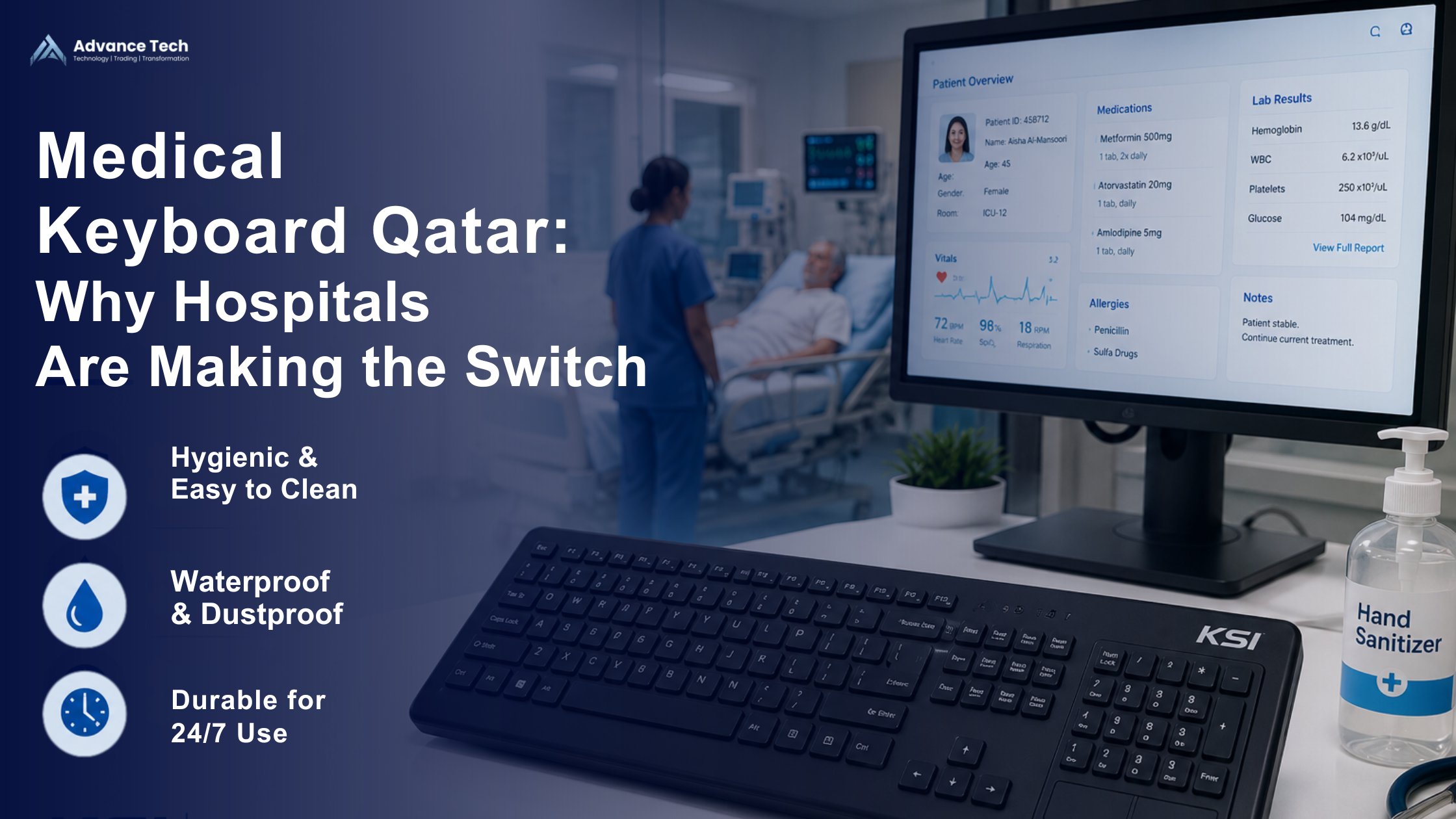
A medical keyboard in Qatar isn’t a niche product anymore — it’s becoming standard clinical infrastructure. Hospitals and healthcare facilities across Doha are replacing standard office keyboards with purpose-built, washable, antimicrobial alternatives. The reason is straightforward: conventional keyboards are infection risks that most procurement teams have historically overlooked.
The Problem Sitting on Every Clinical Workstation
Here’s something that doesn’t get enough attention in healthcare IT conversations: a standard keyboard harbors more bacteria per square centimeter than a toilet seat. That finding, documented in research published in the American Journal of Infection Control, isn’t hypothetical. It’s a reality in every ward, ICU, and outpatient clinic where staff share workstations throughout a shift.
Clinical workstations in Qatar’s hospitals — whether in Hamad Medical City’s specialist centers or in private clinics across Al Sadd — see dozens of users daily. Nurses chart observations. Physicians enter prescriptions. Technicians log diagnostic data. Every interaction with a standard keyboard is a potential vector for pathogen transfer, including MRSA, Clostridioides difficile, and Acinetobacter — organisms that survive on hard surfaces for days.
The keyboard rarely appears on infection control audit checklists. But once you start looking at it critically, its design is almost perfectly engineered to harbor contamination: deep key gaps, porous plastic surfaces, and internal voids that are impossible to clean without dismantling the device entirely.
What Are Medical-Grade Keyboards?
A medical keyboard is a purpose-built input device designed to withstand the cleaning, disinfection, and hygiene demands of clinical environments. These are not premium office peripherals with a marketing rebrand. They are fundamentally different products, engineered from the ground up for healthcare use.
How They Differ From Standard Office Keyboards
Standard keyboards use membrane or mechanical key switches housed in open-frame plastic enclosures. Liquids get in. Debris accumulates. Surfaces cannot be wiped with hospital-grade disinfectants — chemicals like isopropyl alcohol or chlorine-based solutions that degrade standard plastics quickly.
Medical-grade keyboards are sealed — rated IP65 or IP68 in most clinical-grade models, meaning they are fully protected against liquid ingress. You can run them under water, wipe them with bleach solution, or disinfect with UV sanitizers without damaging internal components. Many models use a flat, seamless silicone or polycarbonate surface specifically because it eliminates the gaps where pathogens accumulate.
Features Designed for Healthcare Environments
Beyond waterproofing, clinical workstation keyboards are built with antimicrobial surface protection — silver-ion technology embedded into the keycap or enclosure material that continuously inhibits bacterial growth between cleaning cycles. They also tend to be quieter, which matters in patient areas where noise is already a concern. And because they’re designed for long shift use, ergonomic profiling is typically more deliberate than on commodity office hardware.
Why Hospitals in Qatar Are Upgrading to Medical Keyboards
Infection Control and Patient Safety
Qatar’s National Health Strategy places infection prevention and control at the center of its patient safety framework. For hospital administrators and quality managers working toward Joint Commission International (JCI) accreditation — which Hamad Medical Corporation and a growing number of private facilities in Qatar hold — demonstrable infection control practices extend beyond hand hygiene protocols. Environmental surfaces, including IT equipment, come under scrutiny.
Replacing standard hospital keyboards with medical-grade alternatives is one of the more concrete, auditable changes a facility can make. It’s documentable, measurable, and directly tied to hygiene standards.
Easier Cleaning and Disinfection
Infection control nurses will tell you that equipment people can’t clean easily, people don’t clean consistently. A keyboard that requires disassembly to sanitize effectively won’t be sanitized effectively. Full stop.
Washable keyboards eliminate the friction. A quick wipe with a disinfectant cloth — the same cloth used on bed rails or IV stands — is sufficient. That simplicity drives actual compliance, which is what infection control outcomes depend on.
Compliance With Healthcare Standards
Medical-grade keyboards increasingly appear in procurement specifications for new healthcare facilities in Qatar, including government-funded expansion projects under Qatar Vision 2030. Facilities that embed hygienic IT hardware into their design and procurement standards from the outset avoid retrofitting problems later — both logistically and in terms of accreditation documentation.
Key Features to Look for in Hospital Keyboards
Waterproof and Washable Design
IP65 is the minimum standard worth considering for clinical use — it protects against water jets from any direction. IP68 is preferable in high-acuity areas like ICUs or surgical suites, where cleaning protocols are more aggressive. Look for keyboards that explicitly list the disinfectants they are compatible with, not just general “waterproof” claims.
Antimicrobial Surface Protection
Silver-ion antimicrobial treatment is the most established technology in this category. It doesn’t replace cleaning — nothing does — but it meaningfully reduces bacterial load between cleaning cycles, particularly on high-touch surfaces. Verify that the antimicrobial protection is embedded in the material, not applied as a coating that degrades with repeated disinfection.
Silent Typing and User Comfort
Patient environments require quiet operation. Medical keyboards using scissor-switch or silicone dome mechanisms produce significantly less noise than standard mechanical keyboards. For overnight shifts in patient wards, this matters to staff and patients equally.
Compatibility With Hospital Systems
Your medical keyboard needs to work with your existing clinical workstation infrastructure — whether that’s thin-client terminals, point-of-care tablets, nurse call systems, or EMR workstations running on Windows or Linux. USB and Bluetooth connectivity are standard, but confirm compatibility with your specific clinical software environment before procurement.
Why KSI Keyboards Are Gaining Attention in Qatar
KSI (Keytronic Services Inc.) has built a specific reputation in the healthcare sector for producing keyboards that meet the practical demands of clinical environments without overcomplicating the user experience.
Ergonomic and Hygienic Design
KSI’s medical keyboard range combines sealed, washable construction with low-profile ergonomic layouts that reduce wrist strain during extended data entry sessions. For nurses and physicians entering patient data across multiple shifts, that ergonomic consideration isn’t minor — it’s a factor in staff wellbeing and input accuracy.
Trusted by Healthcare Professionals
KSI keyboards are used across hospital networks in North America and the Middle East, with deployment records in multi-bed acute care facilities and specialist clinics alike. Their products carry relevant certifications and are designed for compatibility with major clinical workstation environments. As KSI keyboard distributors expand their presence in Qatar, procurement teams now have access to these products through local channels with regional support.
Long-Term Reliability in Clinical Environments
The total cost of ownership calculation for medical keyboards looks different from standard IT hardware. A clinical-grade keyboard that withstands 50,000 disinfection cycles over five years costs less — in aggregate — than replacing standard keyboards every 12–18 months due to chemical degradation, liquid damage, or contamination risk. KSI’s build quality is designed for that kind of longevity.
Common Mistakes Hospitals Make When Buying Healthcare Keyboards
Choosing based on upfront price alone. A standard office keyboard costs a fraction of a medical-grade unit. But it can’t be disinfected properly, degrades quickly under clinical cleaning protocols, and creates documented infection risk. The true cost comparison only makes sense over a 3–5 year horizon.
Assuming “washable” means “medical-grade.” Consumer-grade splash-resistant keyboards are not clinical-grade products. Check the IP rating, the chemical compatibility list, and whether the product is explicitly certified or validated for healthcare use.
Skipping compatibility verification. Procurement teams sometimes select keyboards based on catalog descriptions without confirming compatibility with existing clinical software, thin-client configurations, or peripheral management systems. A keyboard that works flawlessly on a standard Windows workstation may create driver issues on a locked-down clinical terminal.
How to Choose the Right Keyboards Distributors in Qatar
The product matters. So does who you buy it from.
Product Authenticity and Warranty
Working with authorized keyboards distributors in Qatar ensures you receive genuine products with valid manufacturer warranties. Grey-market medical hardware — purchased through unauthorized channels — often lacks documentation, may not meet original specifications, and voids manufacturer support. For healthcare procurement, that’s an unacceptable risk.
Technical Support and Deployment
A distributor who handles medical keyboards at scale should be able to support bulk deployment across multiple clinical workstations, advise on configuration for different ward environments, and provide post-deployment support when issues arise. Ask specifically about their experience with healthcare clients, not just general IT procurement.
Experience in Healthcare IT Infrastructure
The best keyboard distributors in Qatar for hospital keyboards understand the broader clinical IT environment — EMR systems, thin clients, infection control standards, and accreditation requirements. That context makes the difference between a vendor who ships boxes and a partner who helps you deploy the right solution for your specific facility.
Frequently Asked Questions
What makes a keyboard “medical-grade”? A medical-grade keyboard is sealed against liquid ingress (IP65 or higher), compatible with clinical disinfectants like isopropyl alcohol and bleach solutions, and typically features antimicrobial surface protection. It’s designed for environments where regular, rigorous disinfection is mandatory — not occasional cleaning.
Can medical keyboards be used with standard hospital EMR systems? Yes. Most medical keyboards connect via standard USB or Bluetooth and are compatible with major EMR platforms including Epic, Cerner, and locally deployed systems. Confirm compatibility with your specific clinical workstation configuration before purchasing at scale.
How often should hospital keyboards be disinfected? Infection control guidelines generally recommend disinfecting shared clinical input devices between each user session and at minimum once per shift. Medical-grade keyboards make this practical — a single disinfectant wipe is sufficient, with no risk of hardware damage.
Are KSI keyboards available through local distributors in Qatar? Yes. KSI keyboards are available through authorized keyboards distributors in Qatar who can support procurement, deployment, and ongoing supply for healthcare facilities across Doha and the wider region.
What’s the expected lifespan of a medical keyboard in a clinical setting? A properly specified medical keyboard used in a clinical environment typically lasts 4–6 years under normal use and regular disinfection — significantly longer than a standard office keyboard in the same environment, which often degrades within 12–18 months under clinical cleaning protocols.
The Right Hardware Is Part of the Standard of Care
A medical keyboard in Qatar is no longer an optional upgrade for forward-thinking facilities — it’s becoming a baseline expectation in serious healthcare environments. The combination of infection risk reduction, compliance documentation, and long-term cost efficiency makes the case clearly.
If your facility is evaluating medical keyboards or looking for authorized KSI keyboard distributors in Qatar, speak with a specialist who understands both the clinical requirements and the local procurement landscape.
Contact our team to get product recommendations, compatibility guidance, and a deployment plan tailored to your healthcare facility.