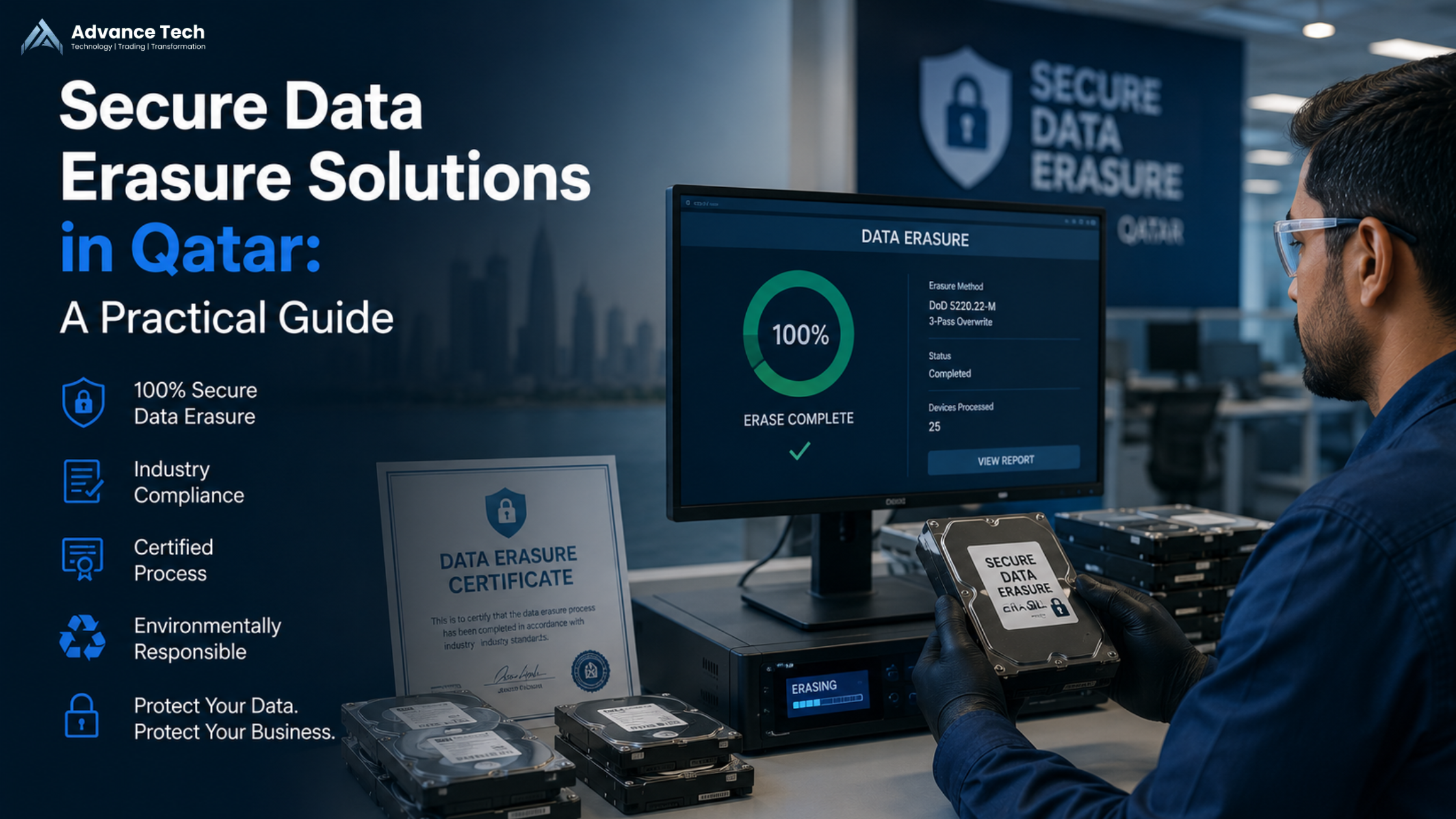
Secure data erasure solutions in Qatar are no longer a niche IT concern. They are a compliance requirement, a cybersecurity control, and an operational necessity for any organization that handles sensitive data — which, in Qatar’s enterprise landscape, is nearly every organization of consequence.
If your company retires devices without certified erasure, the data doesn’t disappear. It waits.
Why Businesses Can No Longer Ignore This
Most IT teams understand endpoint security. They patch vulnerabilities, manage access controls, monitor networks. But when a device reaches end-of-life, that same rigor often evaporates. The machine gets formatted, handed to an asset disposal vendor, or pushed into a storage room — and the data it holds is treated as gone.
It isn’t. A standard format clears the file index, not the underlying data. Forensic tools widely available on the commercial market — the same ones used by data recovery firms — can reconstruct files from a “wiped” drive in hours. According to research by Blancco Technology Group, a significant percentage of second-hand drives purchased through resale channels still contained recoverable data, including financial records and personally identifiable information.
For a bank in West Bay or a healthcare network across Doha, that exposure isn’t theoretical. It’s a regulatory incident waiting to happen.
What Are Certified Data Erasure Solutions?
Certified data erasure is the permanent, verifiable removal of data from storage media using recognized overwriting standards — producing documented proof that the process was completed correctly. It’s not formatting. It’s not deletion. It’s a fundamentally different category of operation.
The Difference Between Deleting, Formatting, and Certified Erasure
Deleting a file removes its directory entry. The data remains on the drive until the sector is overwritten by new data — which may never happen. Formatting a drive clears the file system structure, not the data blocks beneath it. Both operations are reversible with standard recovery software.
Certified erasure overwrites every addressable sector of a storage device using algorithms defined by standards like NIST SP 800-88 (the current U.S. federal benchmark) or DoD 5220.22-M. These methods ensure that original data cannot be reconstructed even with specialized forensic hardware. The process concludes with a tamper-evident certificate identifying the device by serial number, the standard applied, and the date and technician of record.
Why Certification Matters for Businesses
The certificate is what makes erasure auditable. For a financial institution demonstrating compliance with Qatar’s Personal Data Privacy Protection Law, or a multinational managing GDPR obligations for EU citizen data, documentation of data destruction is not optional. An erasure report provides evidence that a specific device was sanitized to a specific standard on a specific date — the kind of evidence that satisfies regulators and client audits alike.
[INTERNAL LINK: Cybersecurity Services Qatar]
Why Businesses in Qatar Need Secure Data Erasure Solutions
Data Privacy and Compliance Risks
Qatar Law No. 13 of 2016 on Personal Data Privacy Protection requires organizations to implement appropriate technical and organizational measures to protect personal data — and to ensure its proper destruction when no longer needed. International organizations operating in Qatar that process EU citizen data face parallel obligations under GDPR Article 17, which mandates verifiable erasure upon request or end of retention period.
Non-compliance carries regulatory penalties. But the reputational damage from a disclosed data breach originating from improperly disposed hardware is typically far more costly than the fine itself.
Cybersecurity Threats From Old Devices
Retired devices are attack surfaces. A decommissioned laptop with cached credentials, saved VPN configurations, or stored authentication tokens is a usable entry point into your network — particularly if it ends up in secondary markets or with third-party vendors who lack your security standards.
This isn’t hypothetical. The 2019 UK Information Commissioner’s Office fine against a major airline [SOURCE] included findings related to inadequate data protection on legacy systems. The principle applies directly to device disposal practices.
Safe IT Asset Disposal and Recycling
Certified erasure enables something physical destruction cannot: reuse. A properly erased device can be resold, donated, redeployed internally, or recycled through responsible e-waste channels without data exposure risk. For organizations managing large device fleets — a government department refreshing 500 workstations, or a hospital network upgrading its clinical terminals — that recovered hardware value is meaningful.
Physical destruction is sometimes necessary, but it should be the exception for media that cannot be software-erased, not the default approach for every retired device.
[INTERNAL LINK: IT Asset Management Solutions]
Features to Look for in Secure Data Erasure Solutions
Audit Trails and Erasure Reports
Every enterprise-grade erasure solution should generate a per-device report that captures the device serial number, storage capacity, erasure algorithm applied, pass/fail verification status, date, time, and operator. These reports need to be exportable, storable, and retrievable for compliance audits without relying on the vendor’s own systems.
Multi-Device and SSD Compatibility
SSD erasure is not the same as HDD erasure. Solid-state drives use wear-leveling algorithms that store data outside the visible address range — meaning standard overwrite methods leave residual data in inaccessible cells. Proper SSD sanitization requires manufacturer-level commands: ATA Secure Erase for SATA drives, or NVMe Sanitize for NVMe drives. Any erasure solution that doesn’t explicitly address SSD handling is incomplete for modern enterprise environments.
Automation for Enterprise Environments
A solution that requires manual intervention per device doesn’t scale to enterprise volume. Look for platforms that support batch processing, network-based erasure (wiping devices remotely without physical access), and integration with IT asset management systems that trigger erasure workflows automatically at end-of-life milestones.
Integration With Existing IT Workflows
Erasure should be a tracked step in your device lifecycle, not a parallel process that IT teams manage separately. The best solutions connect with ITSM platforms like ServiceNow or Jira Service Management, automatically generating and filing erasure certificates within the existing asset record — reducing manual documentation burden and ensuring nothing falls through the cracks.
Why Businesses Choose Pro Device Products
Trusted Enterprise-Level Data Sanitization
Pro Device Products are built to meet the erasure standards that enterprise compliance frameworks require — including NIST SP 800-88 and international equivalents. For organizations that need to demonstrate certified erasure to external auditors, the lineage of the standard matters as much as the technical execution.
Reliable Performance and Scalability
Pro Device solutions handle the full spectrum of modern storage media: spinning HDDs, SATA SSDs, NVMe drives, mobile device flash storage, and removable media. That coverage matters as enterprise device fleets diversify. A solution that works on desktops but struggles with NVMe laptops creates gaps in your data sanitization program.
Compliance-Focused Security Features
Tamper-evident reporting, chain-of-custody documentation, and audit log retention are built into Pro Device’s architecture — not added as optional modules. For Qatar’s government entities and regulated industries, that compliance-by-design approach is considerably more defensible than assembling compliance capabilities from multiple disconnected tools.
Common Mistakes Companies Make During Data Disposal
Relying on free or consumer-grade wiping tools. Tools designed for individual use don’t produce the audit documentation, don’t handle SSD-specific erasure correctly, and aren’t validated against enterprise compliance standards. They give IT teams false confidence without providing real compliance coverage.
Disposing of devices before erasure is confirmed. End-of-lease returns, hardware donations, and vendor collection processes all create windows where devices leave organizational control before erasure is documented. Establish a policy — and a physical process — that no device ships until its erasure certificate is generated and filed.
Assuming physical destruction is always sufficient. Shredding or degaussing destroys hardware but produces e-waste, eliminates resale value, and still requires documentation. For most enterprise devices, certified software erasure is the more efficient, more economical, and equally compliant approach.
How to Choose the Right Pro Device Distributor in Qatar
The product you select matters. So does who supplies it. In Qatar’s market, where healthcare, government, and financial sector procurement operates under specific regulatory and documentation requirements, the right distributor is a meaningful part of your data security posture.
Product Authenticity and Certification
Authorized Pro Device distributors in Qatar provide genuine licensed software, valid manufacturer warranties, and access to the product documentation required for compliance reporting. Grey-market software — purchased outside authorized channels — often lacks update entitlements, technical support access, and the certification documentation auditors expect to see.
Technical Expertise and After-Sales Support
Deploying an enterprise erasure solution at scale involves more than installing software. It requires mapping your device inventory to appropriate erasure standards, configuring batch workflows, integrating with existing IT systems, and training the teams who execute the process. A distributor who provides that technical depth as part of the engagement — not as a billed add-on — reduces deployment risk considerably.
Experience With Enterprise and Government Projects
Qatar’s public sector and regulated industries operate under procurement frameworks that require local presence, Arabic-language capability, and familiarity with specific documentation requirements. Look for a Pro Device distributor in Qatar with verifiable experience in comparable environments — not just general IT supply chain history.
Frequently Asked Questions
What erasure standard should Qatar-based businesses use? NIST SP 800-88 is the most widely accepted standard for enterprise and government environments globally, and it satisfies the technical requirements of both Qatar’s Personal Data Privacy Protection Law and GDPR. Your specific compliance context may require a particular variant — Guidelines for Media Sanitization specifies Clear, Purge, and Destroy levels depending on data sensitivity and media type.
Does data erasure work on encrypted drives? It depends on the encryption implementation. For self-encrypting drives (SEDs), cryptographic erasure — discarding the encryption key — is an accepted sanitization method under NIST 800-88. For software-encrypted drives, the underlying storage still needs to be overwritten using standard erasure methods. Confirm with your erasure solution provider which approach applies to your device types.
How do we handle devices that can’t be software-erased? Damaged drives, certain firmware-locked devices, or media with failed sectors may not support complete software erasure. In these cases, physical destruction — degaussing for HDDs, or shredding for all media types — is the appropriate fallback. Document the reason for physical destruction in the asset record alongside the disposal certificate.
Can we erase devices remotely without collecting them physically? Yes, for network-connected endpoints. Enterprise erasure platforms support remote wiping over a corporate network, which is particularly useful for geographically distributed organizations or devices in satellite offices. Note that remote erasure requires the device to be powered on and network-accessible at the time of the operation.
How long should erasure certificates be retained? Retention periods vary by jurisdiction and industry. Under GDPR, documentation of data processing activities — including destruction — should be retained for as long as the processing relationship exists and typically for several years thereafter. Qatar’s data protection framework similarly requires demonstrable records. In regulated industries like healthcare and finance, five to seven years is a commonly applied retention benchmark. Confirm the specific requirement with your legal or compliance team.
Erasure Is Part of Your Security Posture, Not a Footnote
Secure data erasure solutions in Qatar have become a measurable part of organizational cyber resilience — not just an IT housekeeping task. The devices leaving your organization carry your data until proven otherwise. Certified erasure, properly documented and properly executed, is how you close that risk.
If you’re evaluating Pro Device Products or looking for an authorized Pro Device distributor in Qatar, speak with a specialist who understands your compliance environment and can design an erasure workflow that fits your device volume and regulatory obligations.
Contact our team today for a consultation on certified data erasure deployment for your organization.