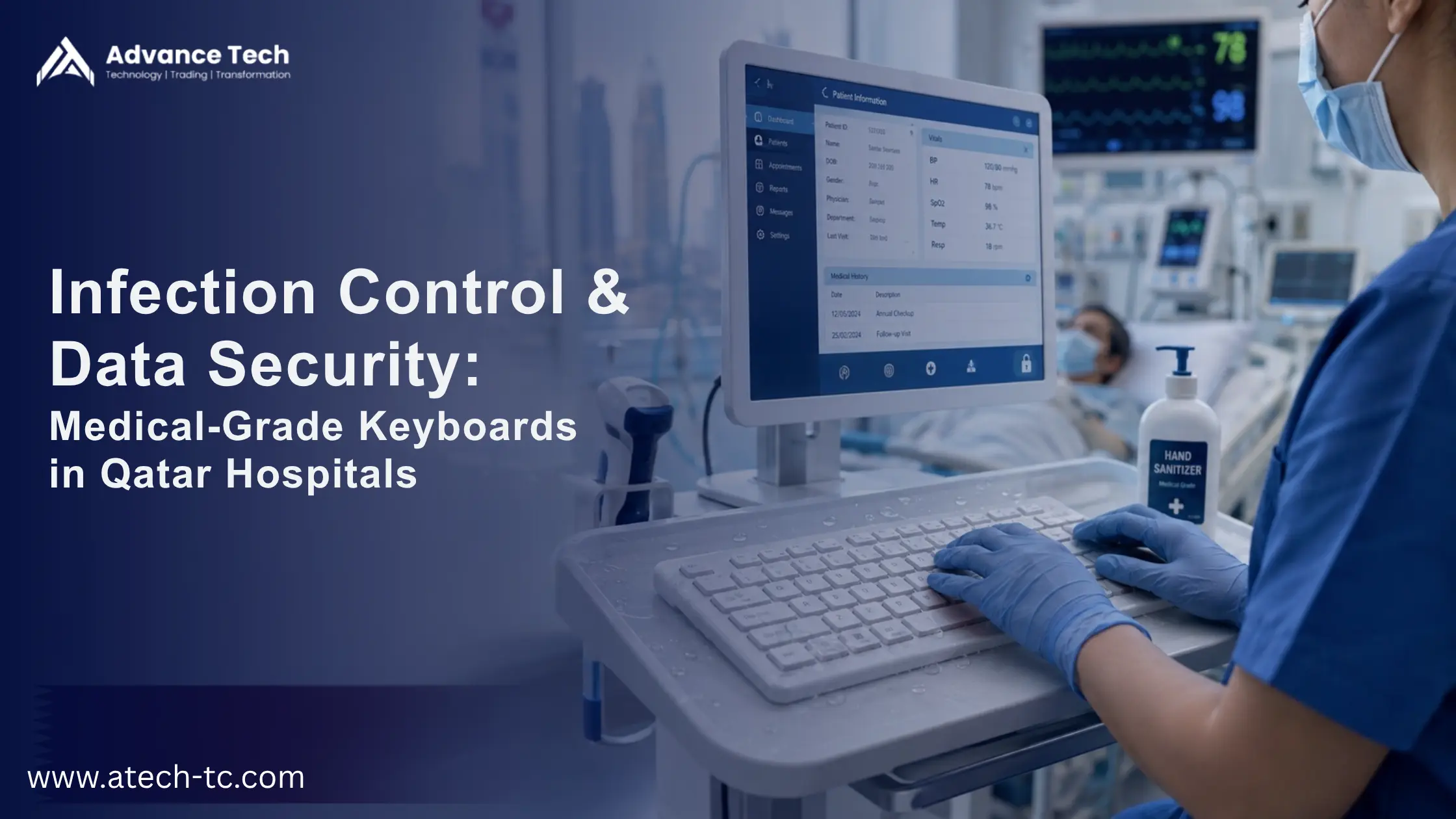
A standard computer keyboard sitting in an ICU or nurses station can carry more bacteria than a toilet seat, sometimes by a wide margin. That’s not a scary headline. It’s a basic fact about deep key wells, tiny crevices, and how many gloved and ungloved hands touch that keyboard in a single shift.
This is exactly the gap a proper medical grade keyboard Qatar hospitals can actually rely on is meant to close. Every hospital in Qatar already knows infection control matters. What fewer teams have fully connected is that the keyboard on a Workstation on Wheels is doing double duty as both a contamination risk and, if it’s the wrong device, a security gap. Fix the hardware and you fix both problems at once.
The Hidden Surface Hazard in Qatar’s Clinical Workstations
Computer Keyboards as Pathogen Reservoirs
Open up a standard plastic keyboard and look underneath the keys. That’s where dust, skin cells, dried bio-fluids, and bacteria settle in, protected from casual wiping by the same key travel design that makes typing comfortable.
In a ward setting, that keyboard gets touched by multiple nurses, doctors, and support staff moving between patients. Every one of those touches is a potential transfer point. Hospital-Acquired Infections don’t just hurt patients, they extend recovery times, add isolation and treatment costs, and quietly inflate a hospital’s operational overhead for weeks after the fact.
Qatar MoPH Directives on Infection Control & Surface Hygiene
Qatar’s Ministry of Public Health, Healthcare Quality Department, the successor to the former Supreme Council of Health, sets clear expectations around environmental surface cleaning as part of its Infection Prevention and Control standards. Point-of-care equipment, including keyboards and input devices, falls squarely inside that Qatar healthcare compliance scope, not just bed rails and trolleys.
A lot of facilities try to bridge the gap with silicone keyboard covers. It sounds reasonable until you actually track how these covers hold up. Under repeated alcohol or bleach wipe-downs, silicone cracks, tears, and yellows faster than most procurement teams expect, and worse, it traps moisture underneath, creating exactly the damp, hidden environment bacteria thrive in.
KSI Medical Keyboards: Engineering Germ-Free Point-of-Care Data Entry
IP65 Sealing & Scrubbable Disinfectant Resilience
This is where IP65 washable keyboards earn their name. An IP65 rating means the keyboard is sealed against dust ingress and low-pressure water jets, which in practical hospital terms translates to spray disinfectants, bleach solutions, and alcohol-based wipes without fluid working its way into the internal electronics.
KSI cleanable keyboards are built with a crevice-free, smooth surface specifically for high-risk clinical environments: ICUs, operating theaters, emergency rooms, and isolation units. There’s no raised key well for fluid to pool in and no seam for bacteria to hide behind. A cleaning staff member can run a wipe across the whole surface in one motion.
Patented LinkSmart Technology for Instant Disinfection
Here’s the practical problem with cleaning any active keyboard: press the wrong key mid-wipe and you can trigger a command, submit a form, or worse, log a clinician out of an active EHR session. KSI’s LinkSmart button solves that with a single press.
• One-touch disengagement: the LinkSmart® button disables all key inputs instantly, so staff can wipe down the entire surface without accidental keystrokes
• No session interruption: the clinician stays logged in, meaning no re-authentication and no lost work mid-shift
• San-a-Key® tracking: the integrated software logs each cleaning cycle, giving infection control teams an actual audit trail instead of a guess
That last point matters more than it sounds. Most hospitals have a cleaning policy on paper. Very few can prove, with a timestamped log, that a specific workstation was actually wiped down between patients.
Quick comparison of what most facilities are relying on today versus what a purpose-built device offers:
| Factor | Silicone Keyboard Cover | KSI IP65 / LinkSmart® Keyboard |
| Disinfectant resistance over time | Degrades, cracks, and yellows under repeated alcohol or bleach wipes | Sealed housing built to withstand daily hospital-grade disinfectant use |
| Moisture trapping | Traps moisture underneath, creating a hidden breeding ground for bacteria | Crevice-free surface with no gap for fluid to pool or hide |
| Cleaning during active use | Must remove cover or risk pressing keys accidentally while wiping | LinkSmart® button disables keys instantly, wipe down without logging off |
| Compliance tracking | No record of when or whether cleaning actually happened | San-a-Key® software logs cleaning cycles for audit and compliance records |
Data Security at the Touchpoint: RFID & Single Sign-On (SSO)
Fast, Secure Access to Patient Electronic Health Records (EHR)
Ask any floor nurse how many times a shift they type their EHR password, and the number is usually higher than anyone in IT expects. On a busy ward, that adds up to real lost time, plus the temptation to leave a session open just to avoid re-typing credentials. This is exactly the friction hospital EHR input hardware is meant to remove.
Embedded dual-frequency RFID readers, using rf IDEAS® technology, remove that friction entirely. This kind of RFID healthcare authentication lets a clinician tap their existing ID badge on the keyboard, get authenticated instantly, and tap out when they walk away. No typing, no shortcuts around password policy, no shared open sessions.
Biometrics & Automated Presence Lock Features
For workflows that need a stronger layer, like e-prescriptions or access to controlled drug records, KSI keyboards support an optional 500 dpi biometric fingerprint sensor for genuine dual-factor authentication. Badge plus fingerprint is a meaningfully higher bar than badge alone.
PresenceLock™ handles the other half of the security equation: what happens when a clinician simply walks away mid-task. It detects when the user has left and automatically locks the terminal, closing the window where an unattended, logged-in EHR session becomes a data privacy violation waiting to happen.
Use Cases Across Qatar’s Healthcare Network
Intensive Care Units (ICUs) and Operating Theatres
These are the environments with zero tolerance for compromise. Sterile field requirements mean dust accumulation and unsealed surfaces simply aren’t acceptable, and a sealed, crevice-free keyboard fits that standard without needing a workaround like a disposable cover.
Mobile Workstations on Wheels (WOWs) & Outpatient Clinics
WOWs move constantly between rooms, wards, and departments, which means their keyboards get touched by more hands per shift than almost any other device in the building. Compact, backlit KSI keyboards are built for exactly this kind of mobile deployment across emergency departments, general wards, and laboratory settings, where low-light conditions and constant handling are the norm rather than the exception.
Procuring KSI Healthcare Hardware in Qatar
Local Healthcare IT Sourcing & Logistics Advantages
Importing specialized infection prevention IT hardware directly comes with a familiar set of risks: no regional warranty coverage, long replacement lead times if a unit fails, and zero local technical support when something goes wrong mid-shift in a live clinical environment.
Sourcing through a local Healthcare IT specialist in Qatar removes that risk. It means localized delivery timelines, pre-configured software integrations that match your existing EHR and SSO setup before the device even arrives, and direct support from a team that understands both the hardware and Qatar’s compliance environment.
Deployment & Demonstration Requests
Before upgrading input devices across a facility, a few criteria are worth checking against any vendor:
• IP65 sealing confirmed for the specific model, not just the keyboard family
• LinkSmart® or equivalent one-touch disinfection function with no session interruption
• RFID compatibility confirmed against your current SSO and EHR platform
• PresenceLock™ or comparable automatic logoff feature for unattended terminals
• Local warranty terms, replacement turnaround, and technical support availability
Getting this right isn’t about buying the most feature-heavy keyboard on the shelf. It’s about closing two gaps, infection control and data security, with one piece of hardware instead of patching each separately.
If your facility is still relying on silicone covers and shared logins on your WOWs instead of a proper medical grade keyboard Qatar hospitals can standardize on, which gap is costing you more right now: the infection control risk, or the time lost to re-authentication every shift?
Ready to Upgrade Your Facility’s Point-of-Care Hardware?
Advance Tech Trading & Contracting is the local Healthcare IT specialist for KSI medical-grade keyboards in Qatar, offering IP65-sealed, LinkSmart®-enabled, RFID-ready devices with local warranty support and pre-configured EHR integration for hospitals and clinics across the country. Request a demo or tender quotation for your facility today.
Visit: www.atech-tc.com